
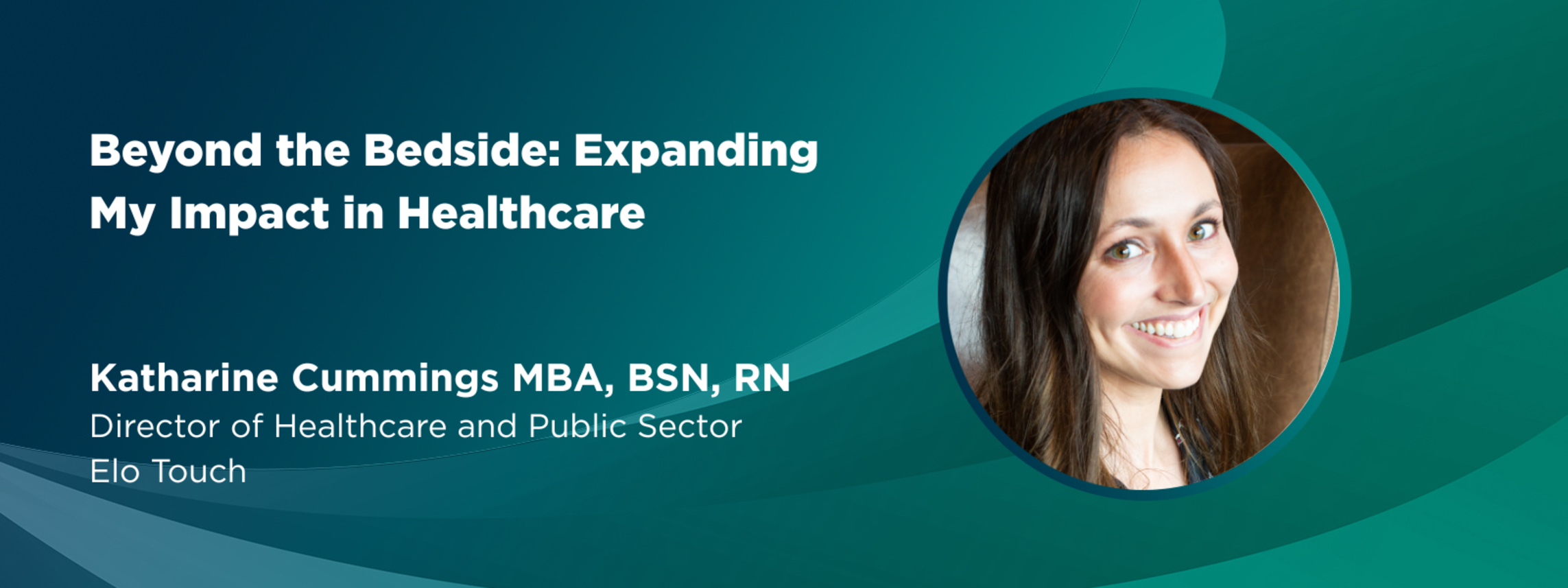
Beyond the Bedside: Expanding My Impact in Healthcare
By Katharine Cummings MBA, BSN, RN, Director of Healthcare and Public Sector, Elo Touch
There was a time in my life when I thought helping people had to look a certain way.
It looked like twelve-hour shifts. Like tired feet and cafeteria coffee. Like alarms sounding down hospital hallways and conversations held quietly at bedsides. It looked like assessing non-healing wounds, managing impossible workloads, and trying to comfort families while pretending you weren’t emotionally unraveling yourself.
For a long time, I believed that was the purest form of impact. When I left bedside nursing, I wrestled with guilt over it.
Healthcare has a way of making people feel like if you step away from direct patient care, you are somehow stepping away from purpose. As though the only meaningful contribution happens inside hospital walls.
But over time, I realized something important: I didn’t leave healthcare. I expanded my impact.
Working at the bedside gave me something no title, degree, or leadership training program ever could. It gave me proximity to human suffering. It taught me how fragile people are when systems fail them. It showed me the emotional weight clinicians carry every single day and how often they are expected to absorb inefficiency in silence.
I saw nurses spending more time fighting technology than benefiting from it. I saw physicians buried under administrative tasks. I saw fragmented systems create frustration for both patients and caregivers. I saw brilliant healthcare professionals burn out not because they stopped caring, but because they cared so much for so long inside systems that made it harder to do their jobs well.
That experience fundamentally shaped the way I think about leadership and innovation.
When I transitioned into healthcare technology, I initially felt like an outsider. I was entering rooms filled with executives, engineers, and strategists while carrying a background many people underestimated. I knew how to stabilize critically ill patients, but suddenly I was learning sales strategy, product positioning, operational workflows, and enterprise technology ecosystems.
At times, it felt like I had to prove that empathy and business acumen could exist in the same person. But the further I moved into healthcare technology leadership, the more I realized the industry desperately needs people who understand both.
What surprised me most was realizing how much meaningful innovation in healthcare depends on collaboration. No single company, platform, or leader solves these challenges alone. Real transformation happens when technology providers, channel partners, healthcare organizations, developers, and operational leaders align around a shared goal: reducing friction for the people delivering care.
The best partnerships are not transactional. They are deeply strategic. They require listening, trust, and a willingness to build solutions that work inside the realities of healthcare environments, not just inside boardrooms or product roadmaps. In many ways, the channel taught me that impact scales through relationships.
Healthcare does not need more disconnected tools. It needs people willing to ask better questions: Does this actually make life easier for clinicians? Does this improve the patient experience? Does this reduce friction or create more of it? Does this technology support human connection or quietly erode it?
Innovation without empathy is just noise.
Somewhere along the way, I realized I had not walked away from healthcare at all. I had simply stepped beyond direct patient care and into a different kind of advocacy. One focused on improving the systems, experiences, and technologies that shape care at scale.
Today, my work looks different than it once did. I am no longer standing at bedsides during shift change. But I am helping shape conversations around the future of healthcare technology, operational efficiency, patient experience, and connected systems that support both caregivers and patients more effectively.
The scale of impact is simply different now. And if I am being honest, I think many women struggle with giving themselves permission to evolve. We are often taught that changing directions means abandoning something. That moving into leadership, technology, strategy, or entrepreneurship somehow distances us from the people we originally set out to help.
I no longer believe that.
The future of healthcare will belong to leaders who can bridge humanity and innovation. Leaders who understand workflows and emotions. Data and burnout. Efficiency and empathy.
Because healthcare is not just about treating illness. It is about designing systems that allow people to care for one another more effectively.
My nursing career taught me how to advocate for people at their most vulnerable. My career in healthcare technology taught me how to advocate for systems that can support millions of those moments at scale.
And maybe that is what growth really is. Not abandoning who you were, but carrying those experiences forward into bigger rooms, harder conversations, and broader opportunities to create change.
I still carry the nurse in me into every meeting I walk into.
She is there when I think about workflow inefficiencies. She is there when I challenge whether technology is actually helping clinicians. She is there when I advocate for better experiences for patients and caregivers alike.
The setting changed. The mission never did. The future of healthcare will not be built by technology alone. It will be built by people willing to collaborate across disciplines, challenge outdated systems, and create solutions grounded in both empathy and action.
That is what healthcare taught me. That is what the channel taught me. And that is the kind of leadership I hope to continue building for the next generation.
I didn’t leave healthcare.
I simply found a way to expand what caring for people could look like.
Bio: Katharine Cummings is the Director of Healthcare and Public Sector at Elo Touch Solutions, where she leads initiatives focused on healthcare technology, patient experience, and connected care environments. With a background in nursing and business, Katharine brings a unique perspective to healthcare innovation by combining frontline clinical experience with strategic leadership in technology and channel partnerships. Throughout her career, she has focused on improving workflows, reducing operational friction, and helping healthcare organizations adopt solutions that better support both caregivers and patients. Passionate about building more human-centered systems, Katharine is committed to advancing technology that strengthens both the patient and clinician experience while helping shape the future of healthcare delivery.