
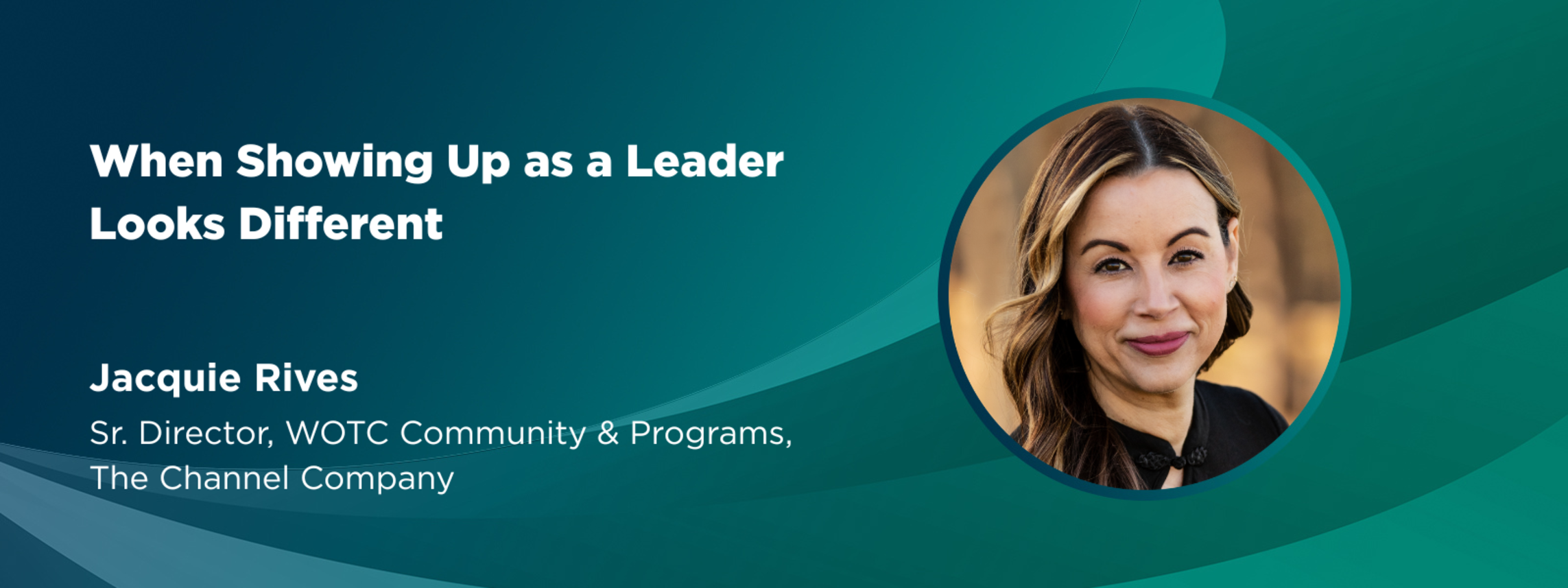
When Showing Up as a Leader Looks Different
By Jacquie Rives, Sr. Director, WOTC Community & Programs, The Channel Company
What if sustainable leadership isn’t about increasing your capacity—but getting better at deciding what deserves it?
At XChange August, I had the opportunity to moderate a conversation about something I think far more leaders are experiencing than talking about:
When Showing Up as a Leader Looks Different
What if sustainable leadership isn’t about increasing your capacity—but getting better at deciding what deserves it?
At XChange August, I had the opportunity to moderate a conversation about something I think far more leaders are experiencing than talking about:
What happens when life doesn’t leave you with 100% to give?
I started the session by asking the audience how many felt their leadership capacity had been stretched more in the last 12 to 18 months than at almost any other point in their careers.
A lot of hands went up.
And I wasn’t surprised.
Because leadership doesn’t happen in a vacuum.
We lead while raising families. Caring for aging parents. Navigating health challenges. Supporting spouses and children. Managing financial pressures. Growing businesses. Losing people we love. Dealing with uncertainty. And sometimes simply trying to keep up with lives that feel increasingly full.
Yet somewhere along the way, many of us learned that being a “strong leader” meant making sure none of that showed.
Keep going.
Be available.
Have the answer.
Carry the load.
Don’t let anyone see you struggle.
But I’m beginning to believe some of our strongest leadership happens when we stop trying to prove how much we can carry.
I Used to Think Leadership Was About Capacity
Earlier in my career, I probably would have measured my leadership capacity by how much I could handle.
How many things could I juggle?
How quickly could I respond?
How many problems could I solve?
How much could I take on before something dropped?
And, if I’m being truthful, there was probably some pride wrapped up in being the person who could handle a lot.
But life has a way of challenging the leadership philosophies we build when everything is going according to plan.
This year did that for me.
My husband experienced serious back issues that ultimately required surgery. For months, our normal life wasn’t normal. There were appointments, uncertainty, additional responsibilities at home and worry about someone I love—all while I was still leading in a demanding role.
For a while, I did what I suspect many leaders do.
I tried to absorb it.
I kept working.
I kept showing up.
And I kept most of what was happening to myself.
Until I realized something:
Showing up doesn’t always mean showing up the same way.
That realization changed the way I think about leadership capacity.
Protect the Glass Balls
One of my favorite ideas from our XChange conversation was the concept of glass balls and rubber balls that Chelsea shared.
When everything feels important, determine which things are glass and which are rubber.
Glass balls break when you drop them.
Rubber balls bounce.
The problem is that many of us treat everything like glass.
Every email.
Every deadline.
Every meeting.
Every request.
Every problem someone brings to us.
They all receive the same urgency.
But they aren't equally important.
Sometimes the glass ball is your family.
Sometimes it’s your health.
Sometimes it’s a struggling employee who needs ten uninterrupted minutes of your attention.
Sometimes it’s the one business decision that really does need you.
And sometimes that thing you are convinced absolutely must happen today?
It can bounce.
Learning the difference may be one of the most important skills we develop as leaders.
Presence Is More Powerful Than Availability
Another idea from the panel has stayed with me:
Presence and availability are not the same thing – an important distinction that Brian and Laura shared during the panel discussion.
We’ve created a culture where responsiveness can masquerade as leadership.
We answer emails at night.
We respond to messages on vacation.
We keep our phones beside us during dinner.
We sit in meetings while simultaneously watching Teams, Slack and our inbox.
Technically, we’re available.
But are we actually present?
There is a difference between giving someone access to you and giving someone your attention.
I’m increasingly convinced that ten minutes of someone's undivided attention can be more powerful than 12 hours of access to them.
People remember when you listened.
They remember when you noticed they weren’t themselves.
They remember when you checked on them during a difficult time.
They remember when you celebrated something important to them.
They remember when you treated them like a person rather than a resource.
That is leadership, too.
Asking for Help Doesn't Make You Less of a Leader
This one has probably been harder for me.
I am naturally much better at being the person people come to than being the person who says, “I need some help.”
During the difficult months with my husband, I eventually shared what was happening with a few trusted colleagues.
And something interesting happened.
The world didn’t fall apart.
No one questioned whether I could do my job.
Instead, people gave me grace.
They stepped in when I needed it.
And perhaps most importantly, they understood.
It reminded me that transparency doesn't require telling everyone everything.
There is a space between pretending everything is fine and sharing every detail of your personal life.
Sometimes leadership sounds like:
“I’m navigating something difficult right now. I’m okay, but I may need some flexibility.”
That's not weakness.
That's context.
And giving people context gives them an opportunity to support us—just as we would support them.
If Everything Requires You, You Haven't Built Capacity
One of the biggest shifts in my own thinking about sustainable leadership is that capacity isn't created by figuring out how to personally accomplish more.
It's created by developing more people who can lead.
That means delegating more than tasks.
It means delegating decisions.
It means letting someone else own something—even when you know you could probably do it faster yourself.
It means resisting the urge to jump in with the answer.
It means allowing people to solve problems differently than you would.
And sometimes it means accepting that 90% done someone else's way is better than 100% done your way if the process helps another person grow.
The goal of leadership shouldn't be to become indispensable.
It should be to build people who don't need us in every room.
That's how teams grow.
And it's how leaders create the capacity to focus on the things that truly require their attention.
Maybe Sustainable Leadership Isn't About Endurance
For a long time, leadership celebrated endurance.
Push through.
Work harder.
Stay later.
Carry more.
Never let them see you sweat.
I don't think that's the leadership many of us need anymore.
Sustainable leadership requires something different.
Self-awareness to recognize when our capacity has changed.
Boundaries to protect what matters.
Humility to ask for help.
Trust to let other people lead.
Wisdom to know when to push forward—and when to pause.
And enough perspective to recognize that sometimes the most important thing we can do isn't more.
It's less.
Less reacting.
Less controlling.
Less proving.
Less carrying things that someone else is perfectly capable of carrying.
Because leadership isn't about proving how much weight we can hold.
It's about knowing what is ours to carry, what we need to put down, and who we can empower to pick something up.
That may be one of the hardest leadership lessons to learn.
I just wish more of us learned it sooner.
And I’d be remiss not to thank the leaders who joined me on stage at XChange August and were willing to make this conversation real. Laura Muysenberg, VP, Marketing & Sales Operations at People Driven Technology Inc.; Brian Ruschman, President of C-Forward, Inc.; and Chelsea Skinner, President of Oversee My IT brought not only their leadership experience, but also honesty and vulnerability to the discussion.
Thank you, Laura, Brian and Chelsea, for being willing to share the lessons you’ve learned, the challenges that have shaped you, and what sustainable leadership looks like in your own lives. Conversations like this matter because they remind us that the strongest leaders aren’t the ones who have it all figured out—they’re the ones willing to keep learning, adapting and showing up authentically.
Bio: Jacquie Rives is Senior Director of Women of the Channel (WOTC) Community and Programs at The Channel Company, where she leads the global vision, strategy, and execution of WOTC’s programs and community initiatives. She is responsible for driving growth, engagement, and impact across a portfolio that includes international leadership summits, strategic partnerships, and content designed to elevate and connect women across the technology channel.
Prior to joining The Channel Company, Rives served as Chief Operations Officer at a managed solutions provider, overseeing project and service teams and leading operational strategy. Her career foundation includes expertise in project management, entrepreneurship, and team leadership, complemented by six years of service in the U.S. Army in both the United States and abroad.
A champion for community and leadership development, Rives is dedicated to creating opportunities that support and accelerate women’s careers. Outside of work, she enjoys traveling, photography, hiking, and skiing. She lives in Georgia with her husband and their rescue pup, Lucy, and is the proud mother of two daughters.