
The Art of Self-Promotion
By Pam Johansen, Americas Channel Leader - Cyber Security
I was the kind of woman who believed that hard work spoke for itself. I poured my energy into a role at a technology company I genuinely loved—going above and beyond, raising my hand for the hard things, and delivering results that didn’t just meet the bar, but moved it. Along the way, I earned recognition from leadership, peers, and even external industry bodies—moments that felt like proof that my impact mattered.
So when I sat in a development meeting with my leader and was told I “provided no value,” and that the awards with my name on them were simply “paid for,” the words landed like a gut punch. In that moment, I realized something far more unsettling than the comment itself: overachieving doesn’t always protect you—and silence doesn’t always serve you.
This was my story—my journey—and it quickly became clear I still had work to do. Stepping back, I faced an uncomfortable truth: I hadn’t done a good job of sharing my own success. I assumed my work would be visible, my impact obvious, my results undeniable. But I didn’t know how to self-promote—or even that I needed to. Merriam-Webster defines self-promotion as “the act of furthering one’s own growth, advancement, or prosperity.” At the time, that definition felt almost selfish. What I came to understand, though, was that self-promotion isn’t about ego or exaggeration—it’s about making your value visible before someone else decides it doesn’t exist.
Still, I struggled. The question of self-promotion kept resurfacing, and I began to understand why there’s so much content devoted to it—articles, books, podcasts, LinkedIn groups. Self-promotion comes in many forms: savvy, subtle, workplace-focused, even tailored for introverts. But regardless of style, success depends on being seen as both competent and likable. In fast-moving organizations, leaders don’t see everything. Much of my work went unnoticed, and the cost was real: missed raises, stalled promotions, opportunities that never materialized.
For women, advocating for ourselves carries extra weight. I was often judged more harshly for speaking up—sometimes most sharply by other women. Add years of “good-girl conditioning” telling us not to boast or take up space, and it’s no surprise I felt uncomfortable talking about my accomplishments, worrying I’d come across as arrogant rather than capable.
I’m going to be very transparent here. Before you can self-promote, you have to understand yourself. I believed that hard work and strong results were enough, but I didn’t realize leaders are often too busy to notice unless we help connect the dots. For me, the root issue was a lack of confidence. At some point, I allowed others to challenge it—I allowed it. Self-doubt grew quietly, reinforced by my own silence.
And yet, at the same time, I was receiving incredible feedback: positive recognition from those I supported and nominations for the 100% club. Something didn’t add up. What I was hearing externally didn’t match what I had started to believe internally.
Climbing back to self-confidence forced me to confront that disconnect—and that’s when everything began to shift. I realized I needed more than reflection; I needed a framework. So, I dug into research and came across an article titled “12 Tips on How to Talk About Your Career Success Without Bragging—or Being Too Humble.” As I read, a few ideas immediately clicked: frame your achievements through impact, tell a compelling story, and accept that some people might feel threatened. These weren’t just tips—they became guiding principles that helped me see my work differently and, finally, speak about it with confidence.
I began reframing my achievements—not as tasks completed, but as outcomes delivered and value created. I documented what I had done, first for myself, and it was powerful. Seeing my contributions written down and tied to real impact reminded me that my work mattered. Most importantly, it helped me recognize—clearly—that I had provided value, even when my confidence tried to tell me otherwise.
Through this journey, I developed my own framework for self-promotion. My advice is simple: take the time to document your achievements and own the impact you’ve made. The format doesn’t matter—the act of acknowledging your value does. For me, I chose PowerPoint, creating a year-over-year timeline that told my story visually and clearly. I captured my roles, key achievements, expanded responsibilities, logos of accomplishments, the organizations I gave back to, events I delivered, and cross-functional initiatives I contributed to. Seeing it all in one place reinforced my confidence and gave me a clear, compelling way to communicate my value.
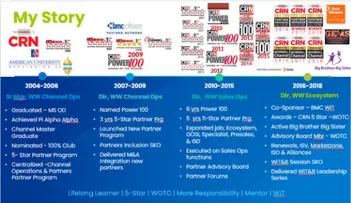
As I built out that timeline, those painful words from my leader echoed again: “You provide no value, and those awards were paid for.” But I knew, without a doubt, that I was delivering real, measurable impact. That’s when I added an important layer to my journey: boundaries. I accepted that some people may feel threatened by your success—and that’s not your problem. Their reaction does not diminish your accomplishments.
That realization was a turning point. I stopped waiting for recognition to come from others and started giving it to myself first. In that space, something shifted. Confidence no longer felt like arrogance, and self-promotion no longer felt like bragging—it felt like truth.
Looking back, my journey with self-promotion wasn’t easy, and it certainly wasn’t natural. But documenting my achievements, owning my impact, and setting boundaries around how others perceive my success changed how I see myself—and how others see me. Self-promotion isn’t about ego; it’s about visibility. If there’s one thing I hope you take from my story, it’s this: don’t wait for someone else to notice your accomplishments. Tell your story. Own your value. Make your impact undeniable.
Bio: In her role as the Americas Channel Leader at a leading cybersecurity organization, Pam Johansen was responsible for recruiting and building a high-performing partner ecosystem across the region. She cultivated strategic alliances with GSIs, MSSPs, hyperscalers, OEMs, distributors, and VARs to drive mutual growth and customer success. Recognized as a visionary channel leader, she transformed the Americas partner organization—driving double-digit growth in partner-sourced revenue and scaling operational excellence while fostering partnerships that fuel innovation and accelerate business outcomes. Johansen's achievements in the channel include recognition on the CRN Women of the Channel List 2009-2025 including the WOTC Power 100 from 2009-2025, and channel program recognition for the CRN 5-Star Partner Program from 2006–2024. She has also served as a Women of the Channel Advisory Board member, Women of the Channel Advocate, Uplevyl Advisor, and past BMC Co-Sponsor of Women of Technology and Business – ERG.