
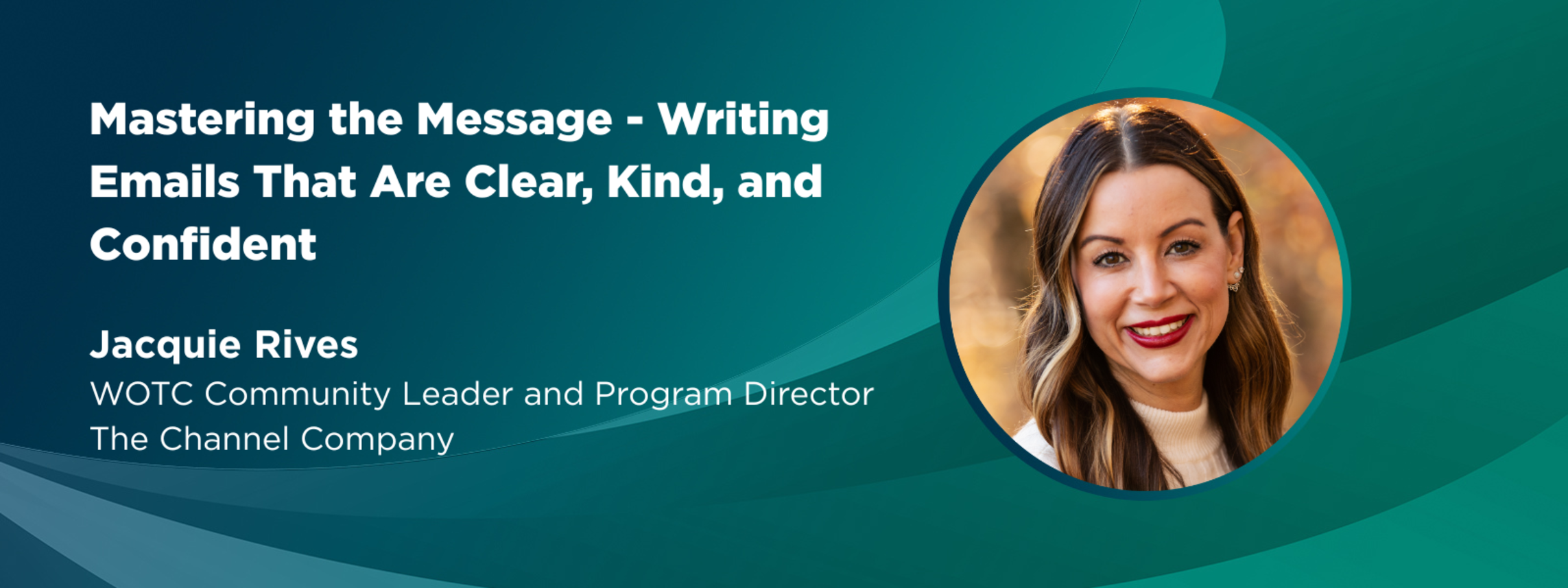
Mastering the Message - Writing Emails That Are Clear, Kind, and Confident
By Jacquie Rives, WOTC Community Leader & Program Director, The Channel Company
Let me start with a confession: I’ve been told my emails are a little… blunt. As someone who prides herself on being efficient, respectful of people’s time, and clear in her communication, this feedback stung at first. But it also made me pause.
We all have experienced tone that doesn’t travel well through text. What feels “direct” to me might feel abrupt or cold to someone else. In a world where much of our communication happens via email, Slack, Teams, or text, the way we say things matters just as much as what we say. So, I’ve been on a journey to sharpen my written communication skills without losing my voice — and I want to share a few lessons I’ve learned along the way.
-
A simple line like: “I need this by Friday.”
-
Might land softer as: “Would it be possible to have this by Friday? Let me know if that timeline works for you.”
-
You're still being clear — just more inviting.
- Start with a greeting and a human touch: “Hope your week is going well.” or “Thanks again for your work on this.”
- Use softening language: “Just a quick note,” “When you have a moment,” “Would you mind…”
That said, don’t bury your ask. Clarity is kindness, too. The trick is striking that balance.
- No greeting or sign-off
- Overuse of periods vs. exclamation points or emojis (where appropriate)
- Short, clipped sentences with no transitions
Try asking yourself: Does this message show I respect their time and their humanity?
One tip I love: imagine you're standing in front of the person. Would you speak this way to them face-to-face? If not, tweak it.
Here’s how to use AI to sharpen your message:
- Tone Check: Ask: “Does this email sound too direct or harsh?” or “Can you make this email warmer and collaborative?” You'll get thoughtful suggestions to soften without sacrificing clarity.
- Rephrasing Ideas: Give the AI your bullet points or rough draft and ask it to rewrite in a tone that’s professional, empathetic, or even enthusiastic — depending on the context.
- Role Play Feedback: Ask the AI to read the message as if they’re the recipient and provide feedback on how it might be perceived
- Polish Under Pressure: When you’re writing late at night, in a rush, or emotionally charged — AI can help take the edge off and ensure you’re leading with intention, not reaction.
Just remember: AI is a tool, not a crutch. Your voice, experience, and values should always take the lead. Having a smart assistant who never tires of fine-tuning tone – well, that’s a game-changer.
Bio: A little about me: I have been a COO, an entrepreneur, a photographer, and served in the US Army for six years both stateside and overseas. I enjoy writing, traveling, photography, hiking, and skiing during my free time. Most importantly, I am a proud mother of two amazing daughters and currently reside in Georgia with my husband, Tony.